Knocking down an attached garage or extension? Protect the shared wall
For owners in England and Wales taking down a building that shares a wall with a neighbour, and for neighbours whose wall will be left exposed. Compare quotes from party wall surveyors.
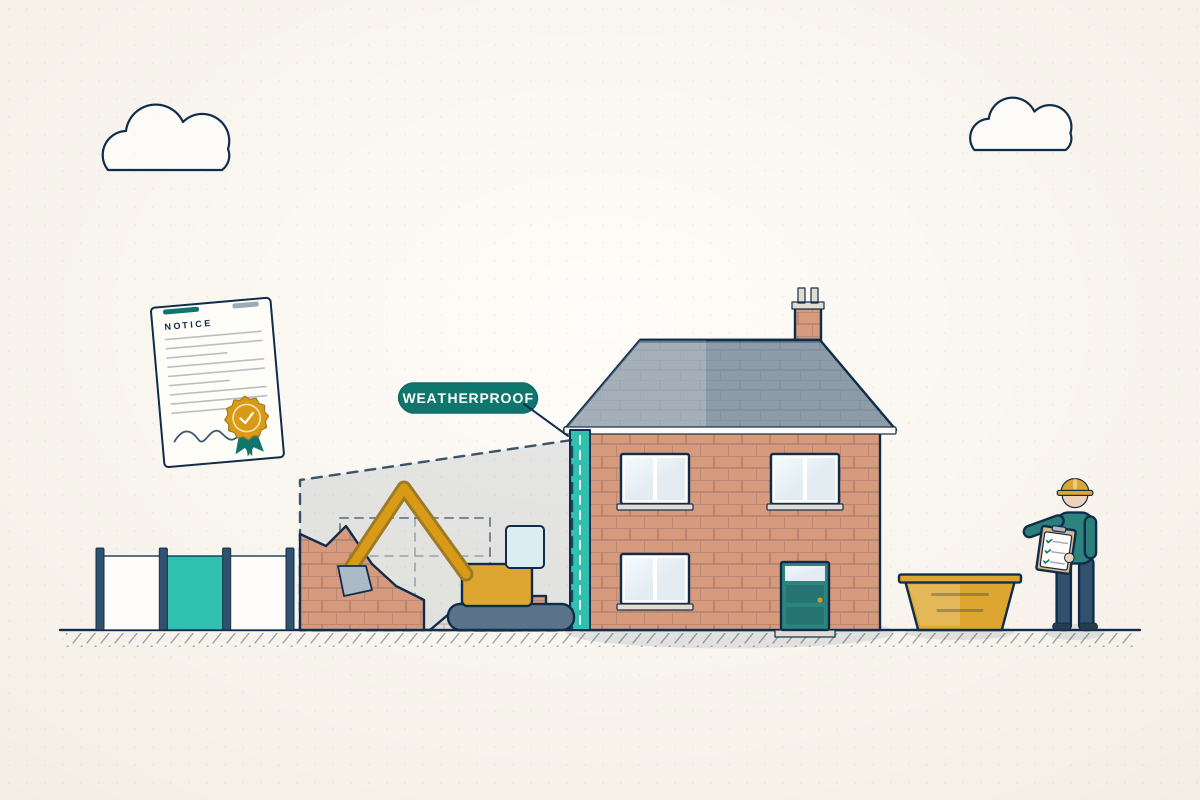
When a garage, extension or whole house attached to a neighbour’s property comes down, the wall it shared is left standing, exposed to the weather, and what used to brace it may be gone. In England and Wales the Party Wall etc. Act 1996 covers this. A party structure notice, the formal notice for work to a shared wall, goes out at least two months before the work. Next door is recorded in a schedule of condition, a written and photographic record. An award, the surveyors’ written agreement, sets out how the wall is supported, weatherproofed and made good. A structural engineer checks the wall, and anything resting on it, before demolition starts. A detached outbuilding with space around it is usually a different matter.
How a professional can help
- Working out what is shared and what is yours: They look at the deeds, drawings and the building itself to see which walls are party walls, which belong to one owner, and which parts, such as chimneys or roof edges, bear on the neighbour’s side.
- Notices for demolishing and exposing the wall: They prepare and serve the notice describing the demolition, the newly exposed face of the wall and how it will be protected, with clear drawings, on every owner who is affected.
- Planning how the remaining wall is supported: They ask your structural engineer to check that the wall left behind is stable, including any bracing or propping needed, before the part that was holding it steady is taken away.
- Weatherproofing and making good next door: They agree how the exposed face is sealed and finished, for example with render, cladding or flashings at roof junctions, and how any damage to the neighbour’s plaster or roof edge is repaired.
- Dust, noise, asbestos and services: They set working hours and dust controls in the award, ask whether an asbestos survey has been done for an older building, and note any gas, electric, water or drain connections that must be capped or moved first.
- Recording next door’s roof edge and chimney: They record the neighbour’s side before demolition, especially the roof edge, chimney, gutters and plaster beside the shared wall, which can be disturbed as a building comes away. They return once the exposed wall is finished and list any repairs needed.
Is this right for you?
- You want to demolish an attached garage, extension or outbuilding and replace it with something new.
- You’re knocking down and rebuilding a house in a terrace or a semi-detached pair.
- You’re a neighbour whose wall will be exposed to the weather after next door’s building comes down.
- Your engineer says the building being removed helps to stabilise the wall it shares with next door.
How the project usually runs
- Survey and engineer’s check: A structural engineer looks at how the building to be removed connects to the shared wall, what rests on that wall, and what support, bracing or new wall the remaining structure needs.
- Party structure notice: The notice describes the demolition and shows the exposed wall on drawings. It goes to each affected owner at least two months before demolition. Speak to the neighbour first so the notice is no surprise.
- Surveyors and a record of next door: Surveyors are appointed, and the neighbour’s property is recorded before any strip-out or demolition, especially the rooms and roofs beside the shared wall.
- Award and demolition method: The award sets the method, working hours, temporary support, weatherproofing of the exposed wall and who pays. Services are disconnected and any asbestos dealt with before the main demolition.
- Demolition, making good and inspection: Demolition goes ahead in the agreed order and the exposed wall is sealed and finished before the weather turns. The surveyors then look at next door again and agree any repairs. Building control signs off whatever replaces the building.
What affects the cost
- How much of the shared wall is exposed, and the finish it needs, such as render, cladding or flashings.
- Whether the remaining wall needs bracing, a new pier or a replacement wall, as the engineer decides.
- Whether the building you are removing touches more than one neighbouring property.
- Whether an asbestos survey and removal is needed before demolition, which is more likely in older buildings.
- The condition of the neighbour’s side, and how much making good is likely to be needed.
- How long the exposed wall will stay open before the new building or finish is in place.
Notices, demolition consents and the four nations
- In England and Wales, demolition that exposes a party wall falls under the Party Wall etc. Act 1996. Scotland and Northern Ireland have different rules. Surveyors work across the whole UK, so ask which rules apply to your property.
- Councils usually need to be told before a building is demolished, with exceptions for some small buildings, and listed buildings need consent first. Buildings in conservation areas may need consent too. Rules differ across the four nations, so ask your council early.
- The party wall notice period, any council demolition rules and the approvals for the new building each run on their own timetable, so start the notice early.
- A new extension or building on the cleared site needs its own planning and building control approvals, supported by the structural engineer’s calculations.
Questions people ask
Do I need party wall notices to demolish an attached garage?
Usually, in England and Wales, if the garage shares a wall with next door, because you are exposing and altering a party wall. The party structure notice must go out at least two months before the work. If the garage stands apart, the Act may not apply, though digging close to next door’s foundations could still count. A surveyor can confirm.
Who is responsible for weatherproofing the exposed wall?
The building owner has to make sure a newly exposed party wall is properly weathered, so rain doesn’t reach the neighbour’s property. The award usually records how, for example with sealing, render or flashing where the neighbour’s roof meets the wall. Agree the finish before demolition starts, not after the weather turns.
Could demolition make the neighbour’s wall unstable?
It can, if the building you remove was bracing the shared wall, or if the neighbour’s roof or chimney rests on it. That is why a structural engineer checks the wall first and designs any temporary support. The surveyors write this into the award, so the neighbour can see how their wall is protected.
Do I need to tell the council before demolishing?
Usually, yes. Councils normally need to be told before a building is demolished, with exceptions for some small buildings, and protected buildings need consent first. Rules differ across England, Scotland, Wales and Northern Ireland, so ask your council or professional early. This is separate from party wall notices, which go to your neighbour.
Will demolition mean a lot of noise and dust next door?
Some, yes, but it can be controlled. The award can set working hours and dust controls, and a careful builder damps the work down and tells neighbours the programme in advance. Talk to your neighbour early, and agree how to reach each other if there is a problem.
Available across the UK
Party wall surveyors cover the whole of the UK. The Party Wall etc. Act 1996 applies in England and Wales; Scotland and Northern Ireland have different rules, and a professional can tell you what applies to your property.
- Get free quotes
- Party Structure Notices
- Schedules of Condition
- Demolition and Façade Retention Engineering
- Party Wall for Rear and Side Extensions
- Party Fence Walls
- Party Wall for Basements
- Party Wall for Beams and Padstones Cut Into the Wall
- Party Wall for Chimney Breast Removal
- Party Wall for Loft Conversions
- Party Wall for New Builds on the Boundary
- Party Wall for Piling and Deep Excavation
- Party Wall for Raising or Rebuilding a Party Wall
- All services
- Find your area