Build a new house or garage on the boundary with notices in place
For self-builders and developers in England and Wales building a new house, garage or outbuilding up to, or across, the boundary. Compare quotes from party wall surveyors before you dig or build.
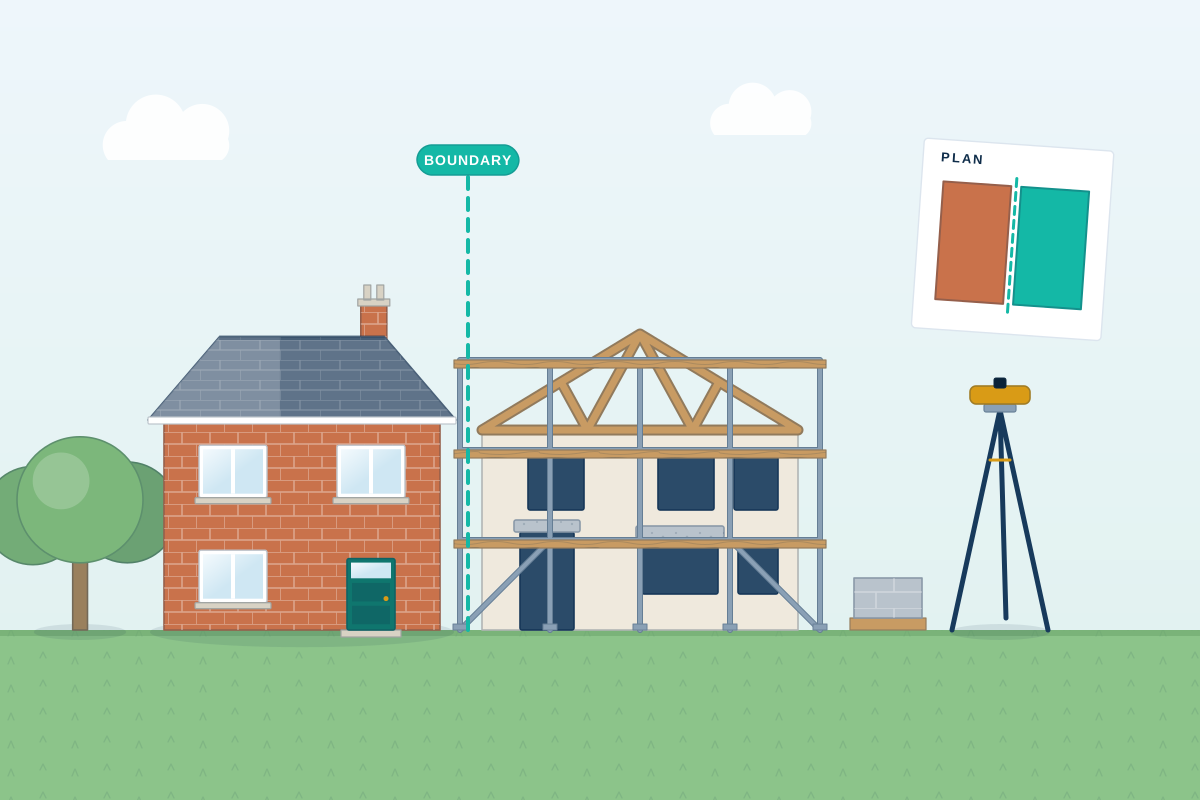
A new house, garage or outbuilding on a boundary raises different party wall questions from an alteration. There may be no shared wall yet, only a line on the ground, with a neighbour’s garden, garage or empty land beside it. In England and Wales the Party Wall etc. Act 1996 can still apply. A new wall built right up to the line can need a line of junction notice, and foundations dug close to and deeper than a neighbour’s can need a notice of adjacent excavation. A party wall surveyor works out which apply, serves them and records what is next door before you dig. If the neighbour objects, the surveyors agree an award, which is the written terms for the work.
How a professional can help
- Where the wall will sit: Checking whether the new wall straddles the boundary, sits wholly on your land or is built against an existing neighbouring wall, because each case is handled differently in the notice and award.
- Line of junction notices: Preparing and serving the notice for a new wall at or across the boundary, with the drawings and a clear description of what is being built and where.
- Foundations near neighbouring buildings: A new house on a gap plot may have foundations deeper than its older neighbours’. The surveyor checks depth and distance against next door and agrees the order of digging, and any propping, where it is close.
- Spotting boundary issues early: Flagging where the boundary position is unclear, or where foundations, eaves or drains could cross the line, so these are sorted out with the neighbour before building rather than after.
- Recording what is next door: Recording the neighbour’s house, garage, boundary wall and garden structures, including existing cracks, before work starts, so any later claim can be judged against a clear record.
- Awards for new-build sites: If the neighbour objects, surveyors agree terms covering working hours, access for scaffolding, protection of the boundary and how any damage is made good.
Is this right for you?
- You are building a new house, garage or outbuilding right up to the boundary.
- Your plot is a gap site or garden plot between existing houses.
- You plan a boundary wall, or a wall of your building, at or across the line with your neighbour.
- Your builder or warranty provider has asked what party wall paperwork is in place.
How the project usually runs
- Boundary and design confirmed: Confirm where the boundary runs and where the walls and foundations will go. The structural engineer sets foundation depths, which decide whether excavation notices are needed.
- Line of junction and excavation notices: Notices for the new wall and for any deep foundations go out with your drawings, each at least one month before the work it covers. If an existing shared structure is involved, that notice needs at least two months.
- Consent or an award: If your neighbour consents in writing, work can go ahead. For excavation, an objection (dissent) or no reply within 14 days brings in surveyors and an award. For the new wall, a neighbour who says no means it must stand wholly on your side of the line.
- Neighbour’s side recorded: The neighbour’s property is recorded in a schedule of condition. The award sets working hours, protection, access for scaffolding and how foundations are dug near next door.
- Build and final check: After the structure is up, the surveyors can revisit next door, compare it with the record and settle any damage.
What affects the cost
- How many boundaries have neighbours, and how many types of notice each one needs.
- Whether foundations must go deep or close to a neighbouring building, which decides if an excavation notice is needed.
- Whether a neighbour answers the notices, and whether an award is needed before digging starts.
- Whether the boundary position is clear or needs to be established first.
- Whether the neighbour has buildings or garden structures to record, or only open land.
Planning, boundaries and the Act
- The Party Wall etc. Act 1996 applies to new buildings on boundaries in England and Wales. Scotland and Northern Ireland have different rules, though party wall surveyors work across the UK.
- Planning permission and Building Regulations (a building warrant in Scotland) are separate from party wall rights, and the rules differ across the four nations. Fire safety rules also affect walls close to a boundary.
- On a new plot, check the title plan and deeds against what is on the ground before the design is fixed. A boundary surveyor or solicitor can help if they do not match.
- Foundations near boundaries are designed by a structural engineer, taking account of ground, trees and drains, and building control normally needs the calculations.
Questions people ask
Do I need a notice if my building is entirely on my own land?
Possibly. A wall built wholly on your land right up to the boundary can still need a line of junction notice, and deep foundations near a neighbour’s building can need an excavation notice. A party wall surveyor can check your drawings.
What if there is no building on the neighbour’s side?
A line of junction notice can still be needed, because it covers boundaries where the neighbouring land is not built on at the line, such as a garden or a field. Excavation notices depend on a neighbouring building or structure being close enough.
Are scaffolding and access on next door’s land covered?
Access, scaffolding and overhanging eaves or gutters are not dealt with by the notices alone. Some can be written into an award where the work is covered by the Act, and others need the neighbour’s separate agreement. Your surveyor can tell which is which.
Does a garage or shed on the boundary need a notice?
A garage or other substantial building can. A garage wall built at the boundary may need a line of junction notice, and digging its foundations close to a neighbouring building may need an excavation notice. A light shed often involves neither, but a surveyor can check.
How is this different from an extension?
A new build often has no existing shared wall to cut into, so the focus is on the boundary and the foundations. An extension attached to an existing house often brings the shared wall in too. Your surveyor will explain which applies.
Available across the UK
Party wall surveyors cover the whole of the UK. The Party Wall etc. Act 1996 applies in England and Wales; Scotland and Northern Ireland have different rules, and a professional can tell you what applies to your property.
- Get free quotes
- Line of Junction Notices
- Notices of Adjacent Excavation
- Party Fence Walls
- New Build Houses
- Party Wall for Basements
- Party Wall for Beams and Padstones Cut Into the Wall
- Party Wall for Chimney Breast Removal
- Party Wall for Demolishing Shared Structures
- Party Wall for Loft Conversions
- Party Wall for Piling and Deep Excavation
- Party Wall for Raising or Rebuilding a Party Wall
- All services
- Find your area