Test whether your land can be developed with outline permission
For landowners, self-builders and small developers who want to establish the principle of building on a site before committing to detailed design. Compare quotes from professionals who prepare outline applications.
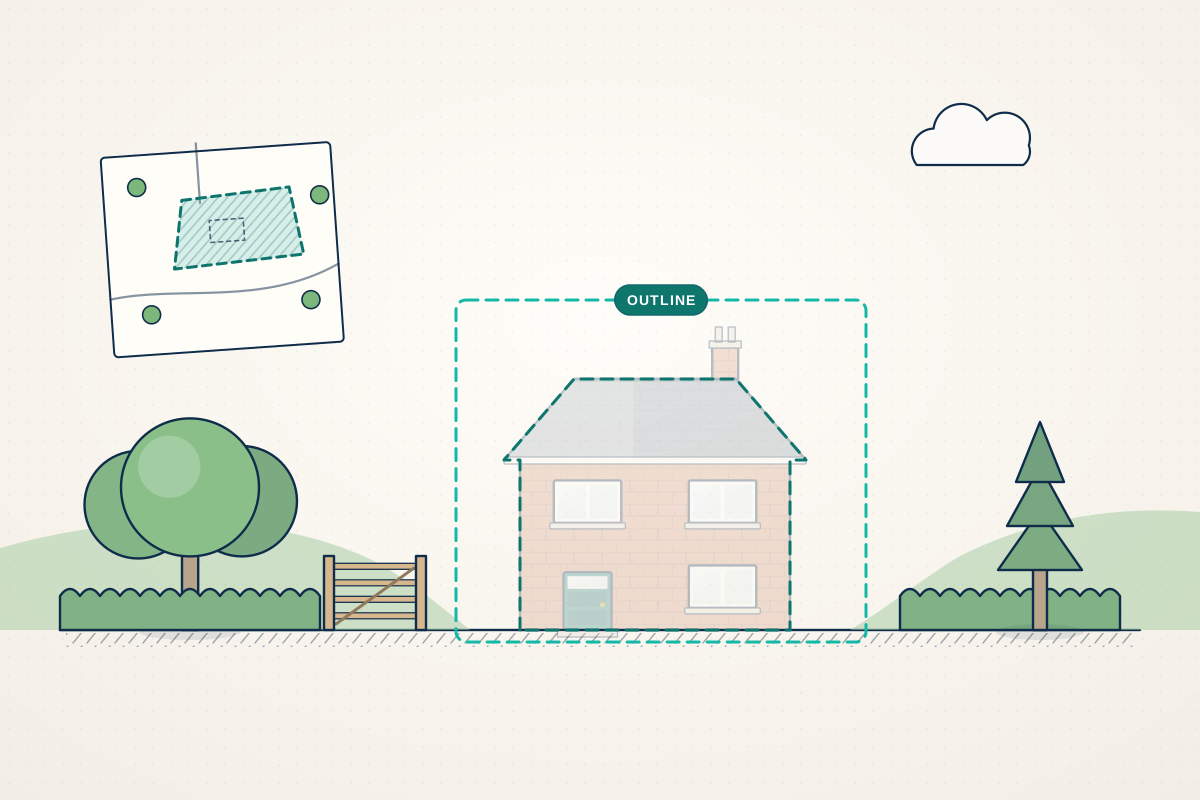
Outline planning permission establishes whether a site can be developed, for example with a new house in a large garden or a few homes on a paddock, without fixing every detail of the design. You choose which of the main matters, typically access, layout, scale, appearance and landscaping, are left for later reserved matters approval. It suits landowners who want planning certainty before selling, and buyers testing a site before they commit. A good professional is honest about what outline can and can’t do: the council still needs enough information on access, constraints and the amount of development to judge the principle, and it can ask for more.
How a professional can help
- Judging whether the principle is realistic: They review the local plan, settlement boundaries, the council’s housing supply position and nearby decisions to give you a candid view of the site’s prospects before you apply.
- Indicative layouts and parameters: They prepare illustrative layouts and, where useful, parameter plans showing building zones, heights and open space, so the council can see how the development would fit.
- Securing a workable access: Access is frequently the deciding issue, so they assess visibility, the route into the site and highway requirements, and advise whether access should be approved now or reserved.
- Covering the key constraints: They arrange the surveys needed even at outline stage, because protected species, flooding and similar issues usually have to be resolved before any permission is granted.
- Setting up the reserved matters stage: They aim for conditions and parameters that leave room for good detailed design later, which matters whether you sell the site or build it yourself.
Is this right for you?
- You own land or a large garden and want to know if housing would be acceptable before paying for detailed design.
- You plan to sell a site and want planning permission in place to give buyers more confidence.
- You’re buying land subject to planning and need to test the principle before completing the purchase.
- You’re a self-builder who wants to secure a plot first and design the house in detail later.
How the project usually runs
- Site appraisal: A professional looks at the site’s policy position, access, constraints and history, and tells you whether outline is the right route or whether a full application would put you in a stronger position.
- Surveys and technical checks: Key surveys are commissioned, typically a topographical survey plus whichever ecology, tree, flood or highway assessments the site needs to support the principle.
- Indicative scheme and application: An illustrative layout, any parameter plans and supporting statements are prepared, stating clearly which matters are applied for now and which are reserved for later.
- Consultation and decision: The council consults neighbours and bodies such as the highway authority, then decides whether the principle is acceptable, usually attaching conditions and sometimes a legal agreement.
- Reserved matters and deadlines: Detailed design follows through one or more reserved matters applications, which must be submitted within the time limit set on the outline decision notice.
What affects the cost
- The size of the site and the amount of development proposed, from a single plot to several homes.
- Which matters you apply for now, since including access or layout means more detailed design and evidence.
- How many surveys the site needs at outline stage, such as ecology, trees, flood risk or highways.
- Whether the site lies outside a settlement boundary or in a protected landscape, which calls for a stronger planning case.
- Whether the council is likely to seek affordable housing or infrastructure payments through a planning agreement.
Outline permission across the UK
- England, Wales and Northern Ireland use outline planning permission; in Scotland the equivalent route is called planning permission in principle.
- England also has a separate permission in principle route for small housing-led schemes, followed later by a technical details consent.
- Councils can ask for full details if they can’t judge the principle without them, which is common in conservation areas and other sensitive locations.
- Outline permission on its own doesn’t allow building; reserved matters approval and the discharge of conditions have to come first.
Questions people ask
Does outline permission mean I can build?
No. Outline permission agrees the principle of development, but nothing can be built until the reserved matters have been approved and any pre-start conditions discharged. It does give you, and any buyer, a firm planning starting point for the detailed design.
Is outline permission the same as planning in principle?
Not quite. In Scotland, planning permission in principle is the name used for the outline-style route. In England, permission in principle is a separate, lighter route for small housing-led schemes that considers only location, land use and amount of development, followed by a technical details consent. Your professional can explain which suits your site.
How much detail does an outline application need?
More than many people expect. The council needs to understand the proposed use, roughly how much development there would be, and where access will be; in England, even if access is reserved, the application must show where the access points will go. The main site constraints also need enough evidence to show the principle works, and the council can ask for more.
Why do landowners get outline permission before selling?
Buyers and developers often prefer land with a permission already in place, because it reduces the planning risk they take on. Outline permission can provide this without the landowner paying for a fully detailed design that a buyer may want to change anyway. A land agent or valuer can advise on how a permission might affect a sale.
How long does outline permission last?
Outline permission sets two deadlines: one for applying for reserved matters and one for starting work once they’re approved. The periods are written on the decision notice, can be varied by the council and differ between nations, so diarise them. If the reserved matters deadline passes, the outline permission lapses.
Available across the UK
Professionals cover the whole of the UK: England, Scotland, Wales and Northern Ireland. Planning and Building Regulations differ between the four nations, and your professional will work to the rules that apply where your property is.
- Get free quotes
- Reserved Matters Applications
- Site and Plot Appraisals
- Infill and Garden Plot Development
- Transport and Parking Statements
- Change of Use
- Conservation Area Projects
- Design and Access Statements
- Discharge of Planning Conditions
- Full Planning Applications
- Heritage and Conservation Architects
- Heritage Statements
- Householder Planning Applications
- All services
- Find your area