Get like-for-like builder quotes with a clear tender package
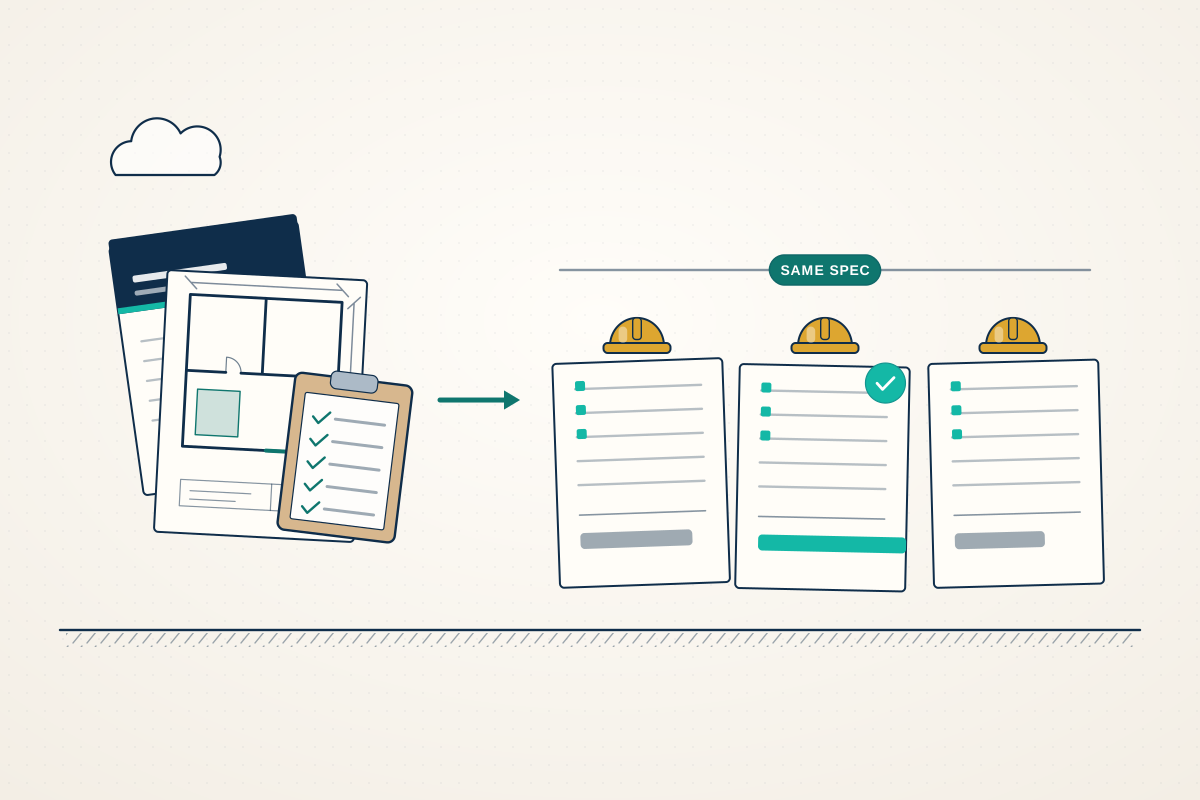
For homeowners and businesses whose plans are approved or nearly ready to build. Compare quotes from professionals who can prepare the drawings, specification and schedule of works that builders price from.
A tender package is the set of documents you send to builders so they all price exactly the same job: technical drawings, a written specification of materials and workmanship, a schedule of works, and the contract terms you intend to use. Without one, each builder fills the gaps with their own assumptions and the quotes can’t be compared fairly. A good professional pulls the package together, decides with you what to fix now and what to leave as a provisional sum, runs the tender, answers builders’ questions, and checks the returns line by line before you choose.
How a professional can help
- Specification and schedule of works: They write down the materials, products, standards of workmanship and every task the builder must carry out, room by room, so far less is left to a builder’s guesswork or turns into an extra later.
- Settling the details before tendering: They help you decide on kitchens, flooring, windows, sanitaryware and finishes now, or set a clear provisional sum for anything still undecided, so it’s obvious what each price includes.
- Choosing builders to invite: They help you draw up a shortlist of builders with the right experience, capacity and insurance for the size of job, and suggest how to check their recent work and references.
- Running the tender fairly: Every builder gets the same documents, return date and pricing form. A question raised by one builder is answered for all of them, so nobody prices from different information.
- Comparing the returned quotes: They line up the prices item by item, spot exclusions, low allowances and unrealistic programmes, and ask builders to clarify before you compare the totals.
- Recommending a builder and contract: They give you a written summary of the tenders with a recommendation, and help you put a suitable building contract in place with the builder you decide to appoint.
Is this right for you?
- Your planning drawings are approved and you now need builders to price the work properly.
- You’ve had quotes from builders that vary so much you can’t tell which one is realistic.
- You want to know exactly what is and isn’t included before you sign a contract with anyone.
- Your project is large enough that a misunderstanding about what’s included could prove expensive once work has started.
How the project usually runs
- Check the design is ready to price: Your professional reviews the planning approval, Building Regulations drawings and structural engineer’s details, and identifies anything missing that builders would otherwise have to guess at.
- Write the tender documents: The specification, schedule of works, preliminaries and tender instructions are drafted, with provisional sums for undecided items and a pricing form so every return follows the same layout.
- Shortlist and issue: You agree a shortlist of builders, check they are interested and available, then issue identical packages with a fixed return date and a chance to visit the property.
- Questions and tender returns: Builders’ queries are answered in writing to everyone. When tenders come back they are opened together and checked for arithmetic errors, exclusions, qualifications and the proposed programme.
- Analysis and appointment: Your professional reports on the tenders, clarifies anything uncertain with the builders, and helps you agree the contract sum and terms with your chosen builder before work starts.
What affects the cost
- Whether technical drawings and structural details already exist, or must be prepared before the package can be written.
- The size and complexity of the job, from a single-storey extension to a whole-house refurbishment or commercial fit-out.
- How much detail you want in the specification, and how many finishes and fittings you’ve already chosen.
- Whether a schedule of works is enough or the project needs a measured bill of quantities from a quantity surveyor.
- How many builders are invited, whether there are interviews or site meetings, and how detailed the tender report should be.
- Whether the fee also covers drawing up the building contract and staying on to administer it during the build.
Approvals to have in place before builders price
- Builders price more reliably once planning permission, or confirmation that the work is permitted development, is in place and any planning conditions are known.
- Detailed Building Regulations drawings reduce surprises. In Scotland a building warrant is needed before most building work starts, and in England, Wales and Northern Ireland many projects use a full plans application.
- If the work affects a shared wall or involves digging near a neighbour’s foundations in England or Wales, the Party Wall etc. Act 1996 may apply, and builders should know about any agreed requirements.
- Health and safety rules (the CDM Regulations in Great Britain, with similar rules in Northern Ireland) mean builders should receive pre-construction information, such as an asbestos survey for older buildings, when they price.
Questions people ask
Why not just send my planning drawings to builders?
Planning drawings show what the building will look like, not how it will be built or finished. Builders pricing from them have to guess about structure, insulation, drainage, electrics and finishes, and each one guesses differently. The lowest quote can simply be the one that has left the most out, with the difference showing up later as extras. A tender package closes those gaps so the prices mean the same thing.
What’s the difference between a schedule of works and a bill of quantities?
A schedule of works lists the tasks the builder must carry out, often room by room, and each builder works out the quantities. A bill of quantities, usually prepared by a quantity surveyor, measures the quantities too, so every builder prices identical amounts. Bills are more common on larger or commercial projects, while schedules suit most home extensions and refurbishments.
What is a provisional sum?
It’s an allowance included in every builder’s price for work that can’t be defined yet, such as a kitchen you haven’t chosen or a repair that can only be assessed once something is opened up. Every builder includes the same figure, so it doesn’t distort the comparison, and it’s adjusted to the actual cost later. Too many provisional sums weaken the certainty of the final price.
How many builders should I ask to tender?
Enough to give genuine competition, but not so many that builders decide their chance of winning isn’t worth the effort of pricing carefully. Builders take a tender more seriously when the list is short and the documents are thorough. Your professional can suggest a sensible number for the size of your project and check each builder is interested before the package goes out.
Should I simply choose the lowest tender?
Not automatically. The lowest price may exclude items, rely on low allowances or assume a programme the builder can’t keep. Compare what’s included, the proposed timescale, the builder’s experience of similar work, their insurance and how they’ve answered questions. A clear tender report sets this out side by side, but the choice of builder is always yours.
Can I tender a project that another designer drew?
Yes. A professional can take over existing planning or Building Regulations drawings, check them for gaps, and add the specification and schedule of works needed to tender. They may need to visit the property and speak to your structural engineer. Check that your agreement with the original designer allows their drawings to be used in this way.
Available across the UK
Professionals cover the whole of the UK: England, Scotland, Wales and Northern Ireland. Planning and Building Regulations differ between the four nations, and your professional will work to the rules that apply where your property is.